Blue Wave 2026? Yes We Can (if we do the work)
What this year’s elections are quietly telling us about Trump, the map, and why we need candidates everywhere.

If this year under Trump has felt like living in permanent chaos mode, you are not imagining it. We have a president who is literally nodding off in the middle of a televised cabinet meeting while the country deals with real problems.
But underneath the chaos, the numbers are starting to move in one clear direction: toward us.
In the latest episode of Breaking the Feed, I walked through why I think a blue wave in 2026 is not a fantasy; it is a real possibility.
1. Special elections are screaming that the environment is shifting
Let’s start with the receipts.
According to a New York Times analysis of 2025 special elections, Democrats have been overperforming their 2024 margins in special congressional races in Florida, Virginia, and Arizona by double digits, in some cases by between 16 and 23 points.

That is not normal. That is not just “good turnout for a special.” That is what it looks like when the political environment is shifting under both parties’ feet.
And it is not just special elections for Congress. In the governor’s races in New Jersey and Virginia this year, Democrats did not just hang on. They won by margins that were much bigger than what we saw in 2024, another sign that the coalition that stopped Trump in 2024 is still very much alive and engaged. When you line up race after race, you start to see the same pattern: whenever there is an election, the results are nudging left.
2. Tennessee’s “red” district just became a single-digit race
Now, let’s talk about Tennessee’s Seventh District, because this is the race that really made Republicans sweat.
Here is the basic story:
TN–07 was drawn to be a safe Republican district.
Trump won it by 22 points in 2024.
On December 2, 2025, there was a special election.
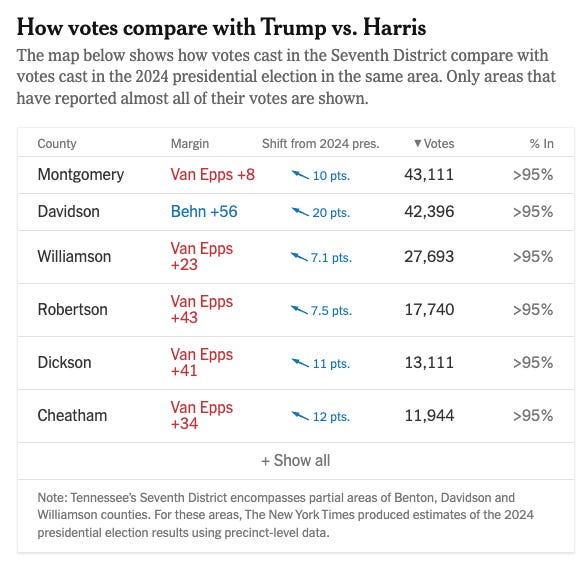
Republican Matt Van Epps beat Democrat Aftyn Behn by under 9 points, roughly 54 to 45.
That is a 12 to 13 point shift toward Democrats in about a year. Every county in the district moved left. Turnout in this special nearly matched the 2022 midterm and could end up higher once all ballots are counted.
Democrats did not win the seat, but they closed the gap dramatically in a district that was designed to be out of reach. Analysts have already pointed out that there are dozens of Republicans sitting in the House right now with smaller victory margins than the 13-point swing we just saw in TN–07.
In other words, if this kind of shift shows up again in 2026, the House map starts to look very different.
3. It is not just Tennessee: local races are sending the same signal
Zoom out a little more.
On December 2nd, voters in Roswell, Georgia, a traditionally conservative suburb, went back to the polls for a mayoral runoff. Democrat Mary Robichaux defeated the Republican incumbent, Kurt Wilson, who was endorsed by Governor Brian Kemp.
This was not a sleepy local contest. Roswell has leaned red for years, and yet voters chose new leadership over an incumbent backed by one of the most powerful Republicans in the state.
Put that next to what we are seeing in New Jersey, Virginia, Florida, Arizona, and Tennessee, and you get a very simple story:
Voters are still engaged.
They are willing to move toward Democrats when we give them a real option.
The so-called “safe” Republican map is not as safe as advertised.
When you add in Trump’s collapsing Gallup numbers and the public image of a president who cannot stay awake in his own cabinet meeting, you start to understand why Republicans are quietly panicking about 2026.
4. What this means for 2026
None of this guarantees a blue wave. Special elections tend to exaggerate swings, maps are still gerrymandered, and Republicans are already working overtime to suppress votes and rewrite rules.
But taken together, the numbers suggest that a blue wave is absolutely possible if the current environment holds:
Double-digit Democratic overperformance in key special elections.
A 12 to 13 point shift left in a deep red Tennessee district, with turnout close to a midterm.
Local flips like Roswell, Georgia, where voters chose change over a Kemp-backed incumbent.
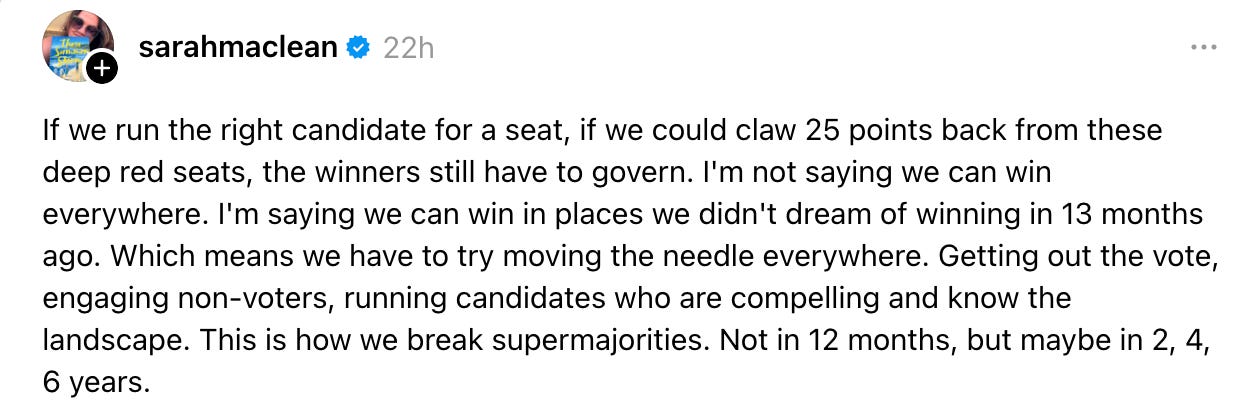
The map is soft. Voters are movable. The question is whether we show up with enough candidates and enough organizing to meet this moment.
5. We need candidates everywhere
Here is the part that makes me excited.
After the results came in for Tennessee’s 7th District, more than 500 people signed up to explore running for office with Run for Something, an organization that helps first-time candidates figure out what to run for and how to get started.

That is exactly the kind of response we need.
The lesson from Florida, Virginia, Arizona, New Jersey, Tennessee, and Roswell is simple:
When Democrats show up and give people a real choice, the numbers move.
So if you have even a tiny voice in your head saying, “Maybe I could do this,” consider this your sign. Check out Run for Something, learn what seats are open near you, and see if something fits.
Blue wave 2026 is not guaranteed.
But the data is telling us that it is possible.
And as a certain former president once said, the answer to “Can we do this?” is still:

I hope you liked this episode! I’m trying to put more content out there that informs people and gets us ready for what is coming in 2026.
Un abrazo,